#include <IProductInstanceInfo.h>
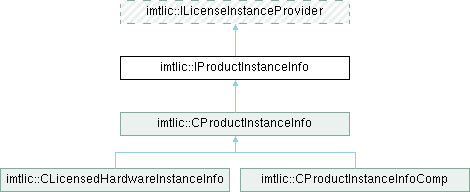
Public Member Functions | |
| virtual const imtbase::IObjectCollection * | GetProductDatabase () const =0 |
| virtual const imtbase::IObjectCollection * | GetCustomerDatabase () const =0 |
| virtual void | SetupProductInstance (const QByteArray &productId, const QByteArray &instanceId, const QByteArray &customerId)=0 |
| virtual void | AddLicense (const QByteArray &licenseId, const QDateTime &expirationDate=QDateTime())=0 |
| virtual void | RemoveLicense (const QByteArray &licenseId)=0 |
| virtual void | ClearLicenses ()=0 |
| virtual QByteArray | GetProductInstanceId () const =0 |
| virtual void | SetProductInstanceId (const QByteArray &instanceId)=0 |
| virtual QByteArray | GetProductId () const =0 |
| virtual QByteArray | GetCustomerId () const =0 |
| virtual QByteArray | GetSerialNumber () const =0 |
| virtual void | SetSerialNumber (const QByteArray &serialNumber)=0 |
| virtual QByteArray | GetProject () const =0 |
| virtual void | SetProject (const QByteArray &project)=0 |
| virtual bool | IsInUse () const =0 |
| virtual void | SetInUse (bool inUse)=0 |
| virtual bool | IsInternalUse () const =0 |
| virtual void | SetInternalUse (bool internalUse)=0 |
| virtual bool | IsMultiProduct () const =0 |
| virtual void | SetMultiProduct (bool isMulti)=0 |
| virtual int | GetProductCount () const =0 |
| virtual void | SetProductCount (int count)=0 |
| virtual QByteArray | GetParentInstanceId () const =0 |
| virtual void | SetParentInstanceId (const QByteArray &parentInstanceId)=0 |
 Public Member Functions inherited from imtlic::ILicenseInstanceProvider Public Member Functions inherited from imtlic::ILicenseInstanceProvider | |
| virtual const imtbase::ICollectionInfo & | GetLicenseInstances () const =0 |
| virtual const ILicenseInstance * | GetLicenseInstance (const QByteArray &licenseId) const =0 |
Detailed Description
Interface for a product instance.
A Product Instance is created when a product is sold, installed, or deployed to a customer. It represents a specific installation of a product and contains:
- The relationship to the product definition (via product ID)
- Customer information (via customer ID)
- Instance-specific identification (instance ID, serial number)
- A collection of activated License Instances
The Product Instance acts as a provider of actually available licenses for this specific installation. It maintains which licenses have been purchased and activated, but does not perform license validation logic at this level - it provides an overview of registered licenses in the product installation.
Key responsibilities:
- Links to product and customer databases
- Manages activated License Instances with their expiration dates
- Tracks instance-specific metadata (serial number, project, usage status)
- Provides access to all licenses available in this installation
Definition at line 54 of file IProductInstanceInfo.h.
Member Function Documentation
◆ AddLicense()
|
pure virtual |
Add an activated license to this product instance.
- Parameters
-
licenseId ID of the license to activate (must exist in the product's license definitions) expirationDate Optional expiration date for the license (invalid QDateTime means no expiration)
- Note
- Full license information is managed by IProductLicensingInfo; the license ID serves as a reference
- See also
- IProductLicensingInfo
◆ ClearLicenses()
|
pure virtual |
Remove all activated licenses from this product instance.
◆ GetCustomerDatabase()
|
pure virtual |
Get access to the customer database. The customer database contains information about all customers.
- Returns
- Pointer to the customer database collection
◆ GetCustomerId()
|
pure virtual |
Get the ID of the customer who owns this product instance. Use this ID to look up additional customer information in the customer database.
- Returns
- Customer ID
- See also
- GetCustomerDatabase
◆ GetParentInstanceId()
|
pure virtual |
Get the ID of the parent product instance. For multi-product instances that distribute licenses to other accounts, this references the parent instance that owns the original licenses.
- Returns
- Parent instance ID, or empty if this is a root instance
◆ GetProductCount()
|
pure virtual |
Get the count of items in this product instance. Valid only if IsMultiProduct() returns true.
◆ GetProductDatabase()
|
pure virtual |
Get access to the product database. The product database contains definitions of all available products.
- Returns
- Pointer to the product database collection
◆ GetProductId()
|
pure virtual |
Get the ID of the product that this is an instance of. Use this ID to look up additional product information in the product database.
- Returns
- Product ID
- See also
- GetProductDatabase
◆ GetProductInstanceId()
|
pure virtual |
Get the unique ID of this product instance. This ID uniquely identifies this specific installation (e.g., MAC address, hardware ID).
- Returns
- Unique instance identifier
◆ GetProject()
|
pure virtual |
Get the project this product instance is assigned to.
- Returns
- Project identifier
◆ GetSerialNumber()
|
pure virtual |
Get the serial number of this product instance.
- Returns
- Serial number
◆ IsInternalUse()
|
pure virtual |
Check if this product instance is marked for internal use only. Internal-use instances are typically for testing or company-internal purposes.
- Returns
- true if marked for internal use only
◆ IsInUse()
|
pure virtual |
Check if this product instance is currently in use.
- Returns
- true if the instance is active/in-use, false otherwise
◆ IsMultiProduct()
|
pure virtual |
Checks whether this product instance represents multiple items (multi-product).
◆ RemoveLicense()
|
pure virtual |
Remove an activated license from this product instance.
- Parameters
-
licenseId ID of the license to deactivate
◆ SetInternalUse()
|
pure virtual |
Set whether this product instance is for internal use only.
- Parameters
-
internalUse true to mark for internal use only
◆ SetInUse()
|
pure virtual |
Set the usage status for this product instance.
- Parameters
-
inUse true to mark as in-use, false otherwise
◆ SetMultiProduct()
|
pure virtual |
Sets whether this product instance represents multiple items.
◆ SetParentInstanceId()
|
pure virtual |
Set the ID of the parent product instance. This establishes a parent-child relationship for license distribution.
- Parameters
-
parentInstanceId ID of the parent instance, or empty to mark as root instance
◆ SetProductCount()
|
pure virtual |
Set the count of items in this product instance. This usually makes sense only if the product is marked as multi-product.
◆ SetProductInstanceId()
|
pure virtual |
Set the unique ID of this product instance.
- Parameters
-
instanceId Unique identifier for this installation
◆ SetProject()
|
pure virtual |
Set the project assignment for this product instance.
- Parameters
-
project Project identifier
◆ SetSerialNumber()
|
pure virtual |
Set the serial number of this product instance.
- Parameters
-
serialNumber Serial number to assign
◆ SetupProductInstance()
|
pure virtual |
Set up this instance for a given product. This establishes the relationship between the instance and its product/customer.
- Parameters
-
productId Logical ID of the product (not a repository/database ID) instanceId Unique identifier for this product instance (e.g., MAC address, hardware ID) customerId Logical ID of the customer (not a repository/database ID)