Simple implementation of color gradient based on interpolation between start and end colors. More...
#include <TColorGradient.h>
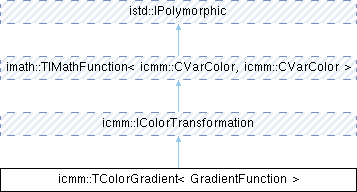
Public Types | |
| typedef IColorTransformation::ResultType | GradientColor |
 Public Types inherited from imath::TIMathFunction< icmm::CVarColor, icmm::CVarColor > Public Types inherited from imath::TIMathFunction< icmm::CVarColor, icmm::CVarColor > | |
| typedef icmm::CVarColor | ArgumentType |
| typedef icmm::CVarColor | ResultType |
Public Member Functions | |
| TColorGradient (const GradientColor &startColor, const GradientColor &endColor) | |
| virtual bool | GetValueAt (const ArgumentType &argument, ResultType &result) const override |
| virtual ResultType | GetValueAt (const ArgumentType &argument) const override |
| Public Member Functions inherited from imath::TIMathFunction< icmm::CVarColor, icmm::CVarColor > | |
| virtual bool | GetValueAt (const icmm::CVarColor &argument, icmm::CVarColor &result) const=0 |
| Get function value for specified argument value. | |
| virtual icmm::CVarColor | GetValueAt (const icmm::CVarColor &argument) const=0 |
| Get function value for specified argument value. | |
| Public Member Functions inherited from istd::IPolymorphic | |
| virtual | ~IPolymorphic () |
Detailed Description
class icmm::TColorGradient< GradientFunction >
Simple implementation of color gradient based on interpolation between start and end colors.
Purpose
TColorGradient provides smooth color transitions between two colors using linear or custom interpolation functions. It implements IColorTransformation, allowing it to generate intermediate colors based on a parameter value (typically 0 to 1).
Design
The gradient is parameterized by:
- Start color: Color at parameter value 0.0
- End color: Color at parameter value 1.0
- Gradient function: Controls interpolation curve (linear, exponential, etc.)
Usage Examples
Gradient Functions
The template parameter GradientFunction controls interpolation:
LinearGradientFunction** (default):
- Simple linear interpolation: f(x) = x
Used by CLinearColorGradient typedef
Custom functions**:
- Implement
static double GetValue(double x) - Return value in [0, 1] for input in [0, 1]
- Examples: ease-in, ease-out, exponential, logarithmic
Applications
- Data visualization: Mapping values to colors
- Heatmaps: Showing intensity or temperature
- Color pickers: Smooth transitions in UI
- Image processing: Color space conversions
- Scientific visualization: False color representations
Best Practices
- Use linear gradients for general-purpose color transitions
- Choose start/end colors in appropriate color space (HSV for hue shifts, RGB for direct mixing)
- Clamp parameter values to [0, 1] for predictable results
- Consider perceptual uniformity - use Lab space for perceptually smooth gradients
- Cache gradient objects for repeated evaluations
- Note
- Parameter values outside [0, 1] are automatically clamped to valid range.
- See also
- icmm::IColorTransformation, icmm::TComposedColorGradient, icmm::CVarColor, icmm::CLinearColorGradient
Definition at line 202 of file TColorGradient.h.
Member Typedef Documentation
◆ GradientColor
| typedef IColorTransformation::ResultType icmm::TColorGradient< GradientFunction >::GradientColor |
Definition at line 205 of file TColorGradient.h.
Constructor & Destructor Documentation
◆ TColorGradient()
| icmm::TColorGradient< GradientFunction >::TColorGradient | ( | const GradientColor & | startColor, |
| const GradientColor & | endColor | ||
| ) |
Definition at line 220 of file TColorGradient.h.
Member Function Documentation
◆ GetValueAt() [1/2]
|
overridevirtual |
Definition at line 258 of file TColorGradient.h.
◆ GetValueAt() [2/2]
|
overridevirtual |
Definition at line 230 of file TColorGradient.h.
References istd::TRange< ValueType >::GetClipped().
The documentation for this class was generated from the following file:
- Acf/Include/icmm/TColorGradient.h